


A new optic isn’t ready to use until it’s zeroed. That means adjusting it so the bullet hits where the dot or crosshair sits at a distance you choose. The process is the same for a pistol red dot, an AR red dot and a hunting scope. Only the distances and click values change.
Bore sighting vs. zeroing: what’s the difference?
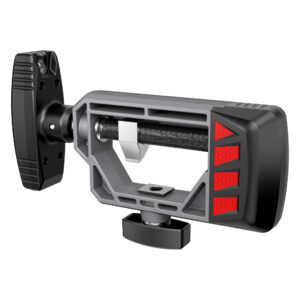
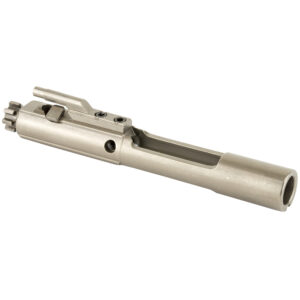
Bore sighting gets you close without firing. You line the optic up with the bore, either by looking through the barrel (possible on many bolt actions and on an AR with the bolt carrier removed) or with a laser bore sighter. It saves ammo and keeps your first shots on paper.
Zeroing is done with live fire. Bullets don’t travel in a straight line, and every load shoots a little differently, so only shooting tells you where your gun actually hits. Bore sighting is a starting point, never the finish.
Mount it right first
Most zeroing problems start with the mount. Before you shoot:
- Use the right mount. Pistol optics need the correct plate or footprint and correct-length screws. Rifle optics need the right ring height and a base that fits your rail.
- Torque to spec. Follow the optic and mount maker’s numbers with an inch-pound torque driver. Vortex, for example, recommends 15 to 18 inch-pounds on its scope rings and says not to use thread locker on ring screws, because it can act as a lubricant and lead to over-torquing. Other makers have different specs, and some call for thread locker on certain screws. Your manual wins.
- Level the reticle on a scope so your elevation adjustments move straight up and down.
- Set eye relief on a scope so you see a full picture from your normal shooting position.
- Mark the screws. A paint-pen witness mark across each screw head shows at a glance if something has loosened.
What distance should you zero at?
There’s no single right answer. Pick the distance that matches how you’ll use the gun.
| Setup | Common zero | Why |
|---|---|---|
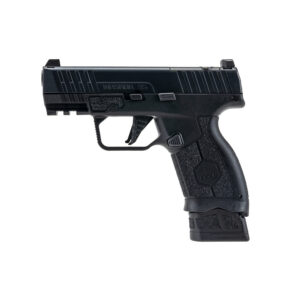
| Pistol red dot | 10 to 25 yards | Most pistol shooting is close. A longer zero, like 25 yards, keeps hits closer to the dot across typical pistol distances. |
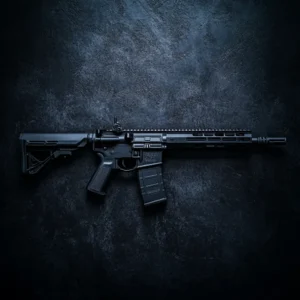
| AR-15 red dot | 50 yards (a “50/200” zero) | Easy to do on a short range, and it works well from close range out to about 200 yards. |
| Hunting or precision scope | 100 yards | A standard reference distance that makes click math and ballistic charts simple. |
Testing published by NRA’s Shooting Illustrated found that on a 9mm pistol, a 25-yard red dot zero kept vertical spread under 2 inches from 5 to 25 yards, while very short zeros left hits noticeably high farther out. The reason is that a slide-mounted dot sits about an inch above the bore, so the closer you zero, the steeper the angle between the dot and the bullet’s path.
What is a 50/200 zero?
Your optic sits above the barrel, so the bullet starts below your line of sight and climbs up through it. With an AR-15 zeroed at 50 yards, the bullet crosses your line of sight at 50 yards, rises a little above it, and then drops back across it again at roughly 200 yards. In between, it stays within a couple of inches of where you aim with common 5.56 loads. One zero, two distances.
Two cautions. At very close range, like across a room, hits land below the dot because of that sight height. And the exact second crossing point depends on your ammo, barrel and sight height, so confirm at distance if you can.
Step by step: how to zero
- Set up safely. Use a range with a proper backstop. Wear eye and ear protection.
- Get steady. Use a bench, sandbags or a rest. You want to see what the gun does, not your wobble.
- Use your real ammo. Zero with the load you’ll actually shoot or carry. Different loads can hit in different places.
- Start close if needed. If you’re not sure you’ll hit paper, start at 10 to 25 yards, then move back.
- Shoot a group. Aim at the same point and fire 3 to 5 careful shots. A group tells you more than one shot.
- Find the center of the group and measure how far it is from your aim point, up or down and left or right.
- Convert to clicks (see below) and adjust. Turret arrows show which way the impact moves. If the group is low, adjust “up.” If it’s left, adjust “right.”
- Shoot another group to confirm. Repeat until the group centers on your aim point.
- Record your zero, including the distance and ammo, and mark the screws if you haven’t.
MOA vs. MRAD: how to calculate clicks
Optics adjust in angles, not inches. The two common units are:
- MOA (minute of angle): 1 MOA is about 1.047 inches at 100 yards. Many shooters round to 1 inch. Many scopes adjust 1/4 MOA per click, which is about 0.26 inch at 100 yards. Many red dots adjust 1/2 or 1 MOA per click.
- MRAD (milliradian or “mil”): 1 MRAD is 3.6 inches at 100 yards. Most mil scopes adjust 0.1 MRAD per click, about 0.36 inch at 100 yards.
Your optic’s manual or turret caps list the click value. Check it before you start.
Because these are angles, the distance per click shrinks as you move closer. At 50 yards, a click moves half as far as at 100. At 25 yards, it moves a quarter as far. So you need more clicks to move the same distance on a closer target.
Example 1: scope at 100 yards. Your group is 3 inches low and 2 inches left. With 1/4 MOA clicks (about 0.26 inch each): 3 ÷ 0.26 is about 11 clicks up, and 2 ÷ 0.26 is about 8 clicks right. With 0.1 MRAD clicks (0.36 inch each): about 8 clicks up and about 6 clicks right.
Example 2: pistol red dot at 25 yards. Your dot adjusts 1 MOA per click. At 25 yards, 1 MOA is about 0.26 inch. Your group is 1 inch high, so you’d adjust about 4 clicks down.
If you’re not sure, make the adjustment, shoot a group and check. Small errors get fixed on the next group.
Common zeroing mistakes
- Chasing single shots instead of shooting groups.
- Adjusting the wrong direction. Follow the arrows, which show where the impact moves.
- Loose or over-tightened mounts. Both can cause a zero that wanders.
- Switching ammo after zeroing.
- Zeroing from an unsteady position.
- On scopes, ignoring parallax or eye relief, which can shift where you see the reticle.
- Assuming a bore sight is a zero.
If your zero still won’t settle after these checks, look at the gun itself. A fouled bore or loose parts can open up groups. See how to clean a gun.
Stay safe at the range
Follow the range’s rules and commands. Keep the muzzle pointed downrange, keep your finger off the trigger until you’re on target, and know what’s beyond your target. When you look through the bore during bore sighting, make sure the gun is unloaded and the action is open or the bolt is removed. Never try to bore sight a loaded gun.
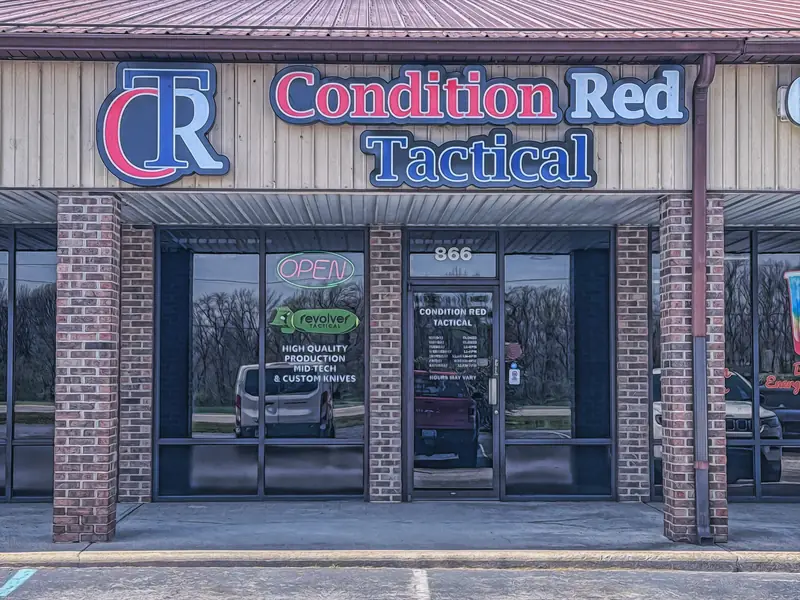
Mounting and zeroing help at Condition Red Tactical
We offer a scope mount and bore sight for $35 in labor, and a test fire / sight alignment for $20 plus ammo. Parts are extra. Labor isn’t taxed, and parts are charged 7% Indiana sales tax. Bore sighting gets you close, so plan to confirm your zero with live fire at the range. See the full list on our services page. Shopping for an optic? Browse red dots and holographic sights or the full shop.
Prices and product instructions change. This guide is general education, not a substitute for your firearm’s or optic’s owner’s manual or a qualified gunsmith. If you’re unsure, ask the shop before you start.
Common Questions
Can I zero a red dot without shooting?
You can bore sight it without shooting, which gets you close. A true zero needs live fire, because the bullet's path and your ammo determine where it actually hits.
How many clicks is 1 inch at 100 yards?
With 1/4 MOA clicks, about 4 clicks moves impact roughly 1 inch at 100 yards. With 0.1 MRAD clicks, about 3 clicks moves it roughly 1 inch.
Why did my zero change?
Common causes are a loose or over-tightened mount, different ammo, removing and reinstalling the optic, or a hard knock. Check your witness marks and confirm zero again.
Should I zero my pistol red dot at 10 or 25 yards?
Both are common. A longer zero tends to keep hits closer to the dot across typical pistol distances, but a shorter zero is easier on small ranges. Pick one, then practice at the distances you expect to shoot.
Do red dots need to be re-zeroed after a battery change?
Changing a battery usually doesn't affect zero, but some designs require removing the optic to reach the battery. If yours does, confirm zero afterward.